

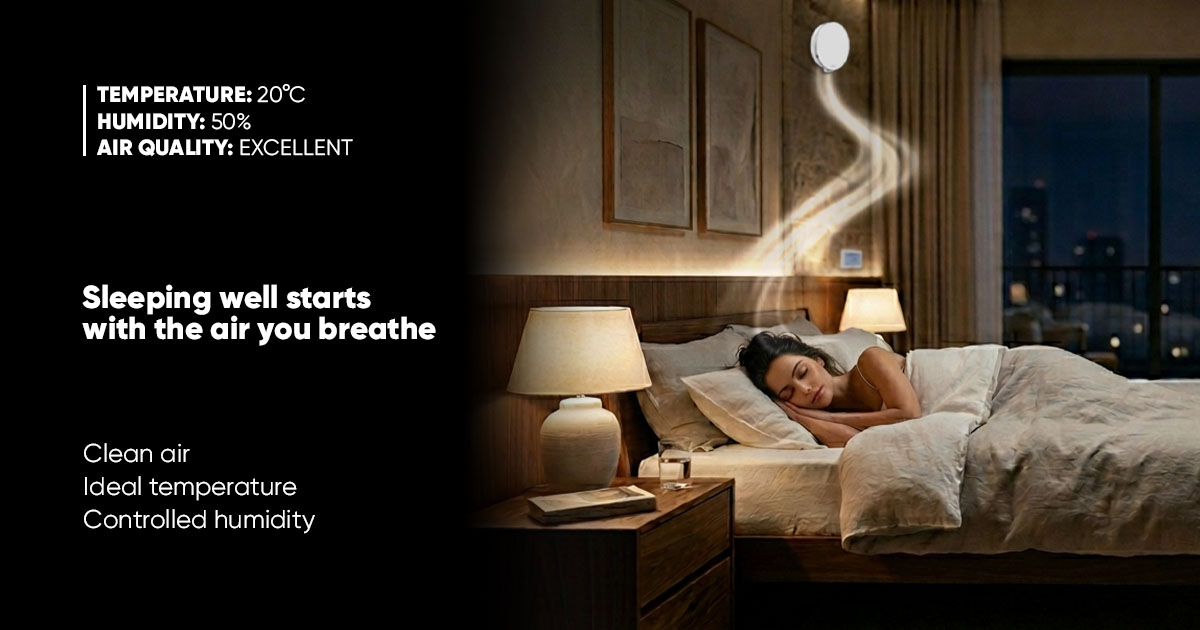
There’s a saying we all know: “April, sweet sleep.” As the days grow longer and temperatures become milder, sleep seems to come more easily. But today we know that simply sleeping is not enough—we need to sleep well. And to do so, the environment in which we rest plays a fundamental role.
An increasing number of studies show that indoor air quality directly affects sleep quality. During the night, air quality tends to worsen simply because we spend many hours in a confined space without proper air circulation. Most people sleep with doors and windows closed, leading to a buildup of pollutants and CO₂ in the room.
When the air in the bedroom becomes “stale,” micro-awakenings can occur, interrupting or fragmenting REM sleep phases and reducing overall sleep quality.
So, what is the recipe for restorative sleep?
To sleep well, it is essential to create a precise balance between several factors: CO₂, temperature, and humidity.
CO₂: the invisible enemy of sleep
During the night, as we breathe, we consume oxygen and produce CO₂. In a closed or poorly ventilated room, levels can easily exceed 1000 ppm, a threshold beyond which air quality begins to deteriorate.
1000 ppm (parts per million) of CO₂ means that out of 1,000,000 air molecules, 1000 are carbon dioxide (approximately 0.1% CO₂ in the air). Optimal levels for well-ventilated indoor environments should range between 600–800 ppm. Above 1000 ppm, the air starts to feel stale and less healthy.
High CO₂ levels in bedrooms are associated with lighter, less restorative sleep. Some studies also point to poorer cognitive performance the following day.
Temperature and humidity: the right balance makes the difference
The ideal temperature for sleep generally ranges between 18°C and 20°C. Higher values can disrupt REM sleep, while temperatures that are too low may cause awakenings.
Humidity is also a key factor: in winter, if the heating system stays on for too long during the night, the air becomes dry and can irritate the respiratory tract. On the other hand, excessively high humidity can cause discomfort, sweating, breathing difficulties, and over time promote the formation of mold and dust mites.
Ideally, humidity should be maintained between 40% and 60% to ensure optimal comfort and health benefits.
Why opening windows is not the solution
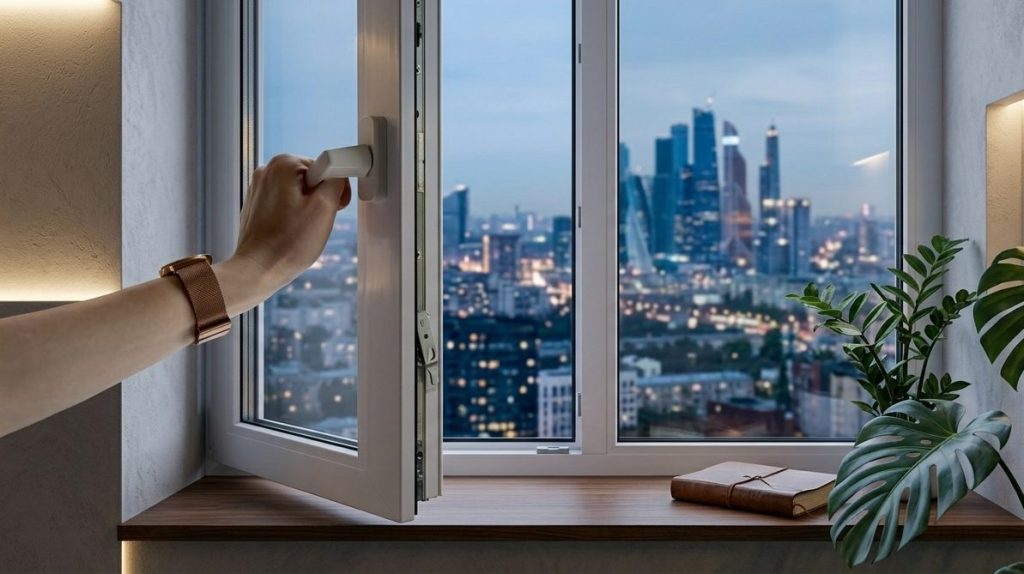
One might think that opening windows is the easiest and quickest way to get fresh air—but in reality, it’s not that simple. There are several drawbacks:
- In winter, opening windows for a few minutes is not enough to properly renew the air and also leads to energy loss
- In summer, it is often too hot to sleep with windows open, and mosquitoes become a problem
- In urban areas, opening windows means letting in pollutants and fine particles, which worsen indoor air quality rather than improve it (in every season)
So, what can you do to have fresh, healthy air without opening windows?
Sleeping better is a system matter
Ensuring optimal conditions throughout the night is not easy if you rely only on manual solutions like opening windows. A more advanced approach is needed—one that can automatically manage indoor comfort and also counteract high CO₂ levels, as well as the presence of dust, mold, pollen, allergens, and VOCs released by furniture and household products.
This is where Fantini Cosmi solutions come into play.
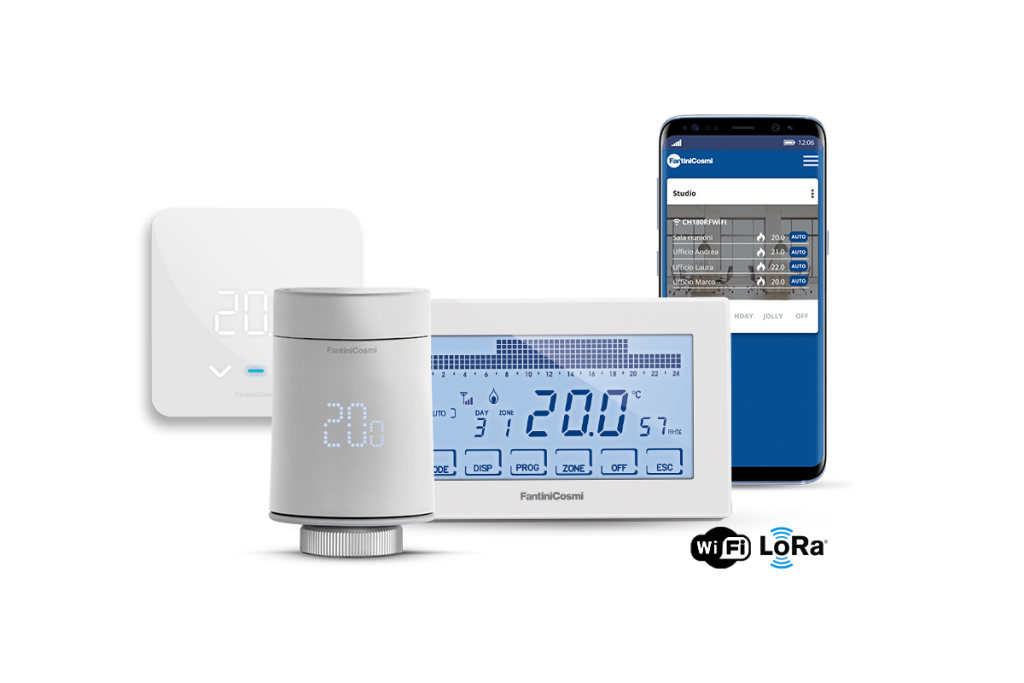
Wireless multi-zone temperature control
Fantini Cosmi’s wireless multi-zone temperature and humidity control system allows you to manage heating and cooling by adjusting temperature and humidity in each individual room of the house. You can program specific night-time profiles to avoid energy waste while maintaining ideal comfort.
This way, the bedroom can always have perfect conditions for rest, without compromise. The system components are modular, flexible, and adaptable to any type of installation (radiators, fan coils, underfloor systems), both in centralized and independent heating systems.
Ventilation and air purification with RHINOCOMFORT 3
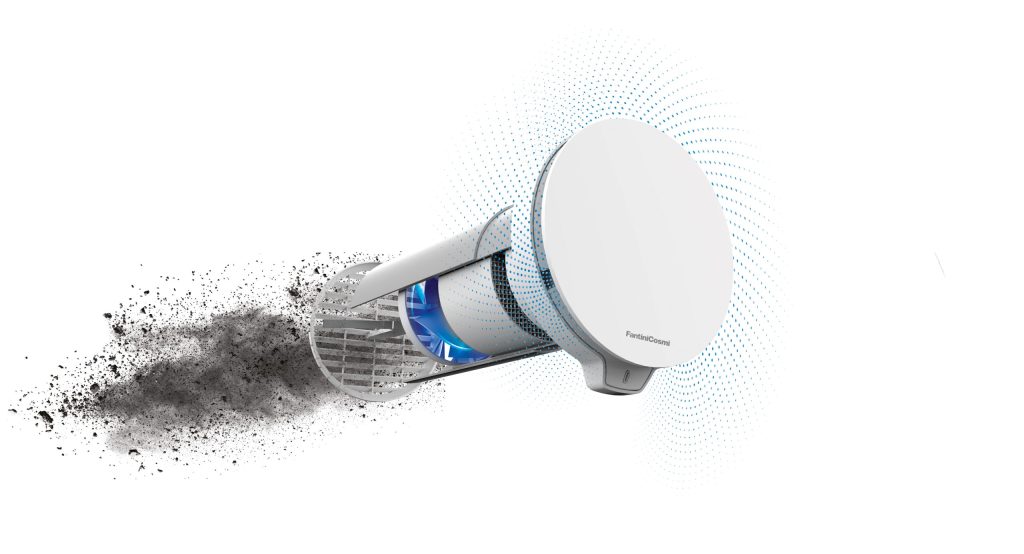
When it comes to air exchange and quality, the ideal solution is RHINOCOMFORT 3, the decentralized mechanical ventilation system that not only renews the air but also purifies it.
Thanks to a patented air sanitization system, RHINOCOMFORT 3 cleans incoming air while recovering heat from outgoing air, ensuring both comfort and energy savings. Smart sensors automatically adjust ventilation, maintaining optimal indoor conditions at all times.
Continuous air exchange reduces CO₂ concentration, eliminates up to 99.6% of viruses and bacteria, lowers PM2.5, PM10, VOCs, and excess humidity—helping to create a healthier and more comfortable environment.
All this without opening windows and without thermal losses.
Easy control via app
Both the wireless multi-zone temperature and humidity control system and RHINOCOMFORT 3 can be managed through the Fantini Cosmi Intelliclima+ App—a true hub for indoor multi-comfort.
Rediscover the true meaning of “sweet sleep”
Today, “sweet sleep” takes on a new meaning: it’s not just about being lulled by the changing season, but about consciously creating the conditions for healthy, restorative rest.
Because sleeping well is not a luxury—it’s a necessity, and much depends on the air we breathe.